
Incomplete tax records do not always require filing another return. If a personal tax return was filed with missing or incorrect information, first identify what is missing, obtain reliable documentation and determine whether the assessed return needs to be changed.
Wait until the CRA issues the notice of assessment before requesting a change. If another change request is already being processed, wait for the CRA’s response before submitting an additional request. The appropriate next step depends on the missing information and whether the assessed amounts are affected.
For more practical tax-preparation guides and checklists, visit the ACCPAS Insights resource centre.
1. Wait for the notice of assessment
Wait until the CRA has assessed the original return and issued the notice of assessment before requesting a change. Review the notice against the filed return and retain a copy with the tax records.
If a change request has already been submitted, wait for the CRA’s response before requesting another change to the same return.
2. Create a missing-information list
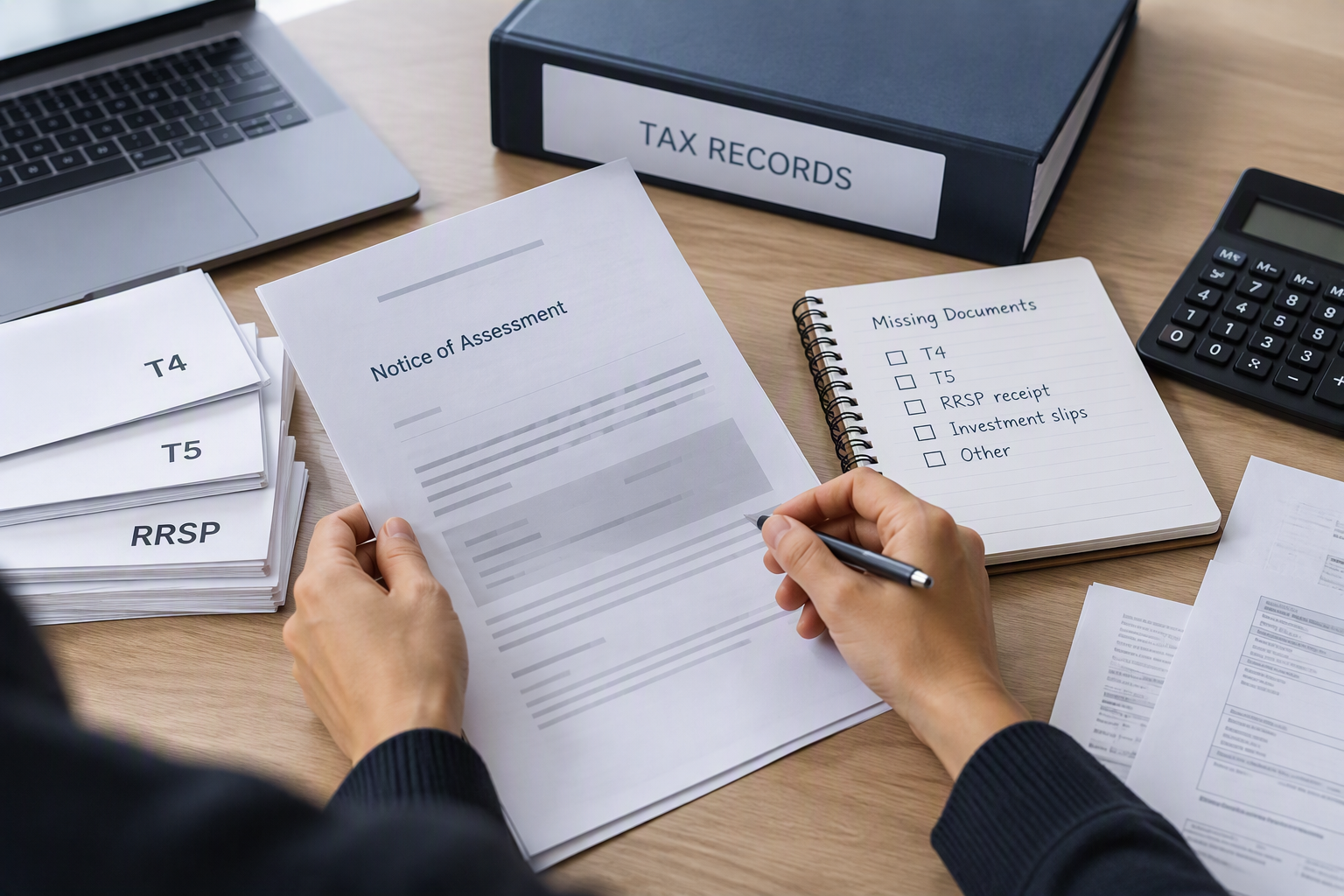
List each missing slip, receipt, income amount, deduction, credit or transaction. Record the issuer, tax year, date received and amount originally reported, if any.
Separate confirmed errors from items that are merely uncertain. A missing document does not automatically mean the assessed result will change.
3. Obtain the missing documents
Ask the employer, financial institution or other issuer for a copy of a missing slip. A current-year or prior-year slip may also be available through the taxpayer’s CRA account after the issuer has submitted it to the CRA.
Do not assume that every expected slip will already be available through CRA services. The CRA cannot provide a slip until the issuer has submitted it.
4. Compare new information with the assessed return
Compare the new record with the filed return and notice of assessment. Determine whether the information changes reported income, tax withheld, a deduction, a credit or another assessed amount.
Document the affected line or claim and retain the calculation. If the reporting treatment is uncertain, obtain professional advice before submitting a change.
5. Use the correct adjustment method
A change to an assessed return may be requested through Change my return in the taxpayer’s CRA account, through ReFILE in eligible certified tax software, or by mail using the applicable adjustment process. Restrictions apply, and not every change can be requested through every method.
For an online request, retain the confirmation number and summary of changes. The CRA’s current guidance says supporting documents for an online request should be provided only if the CRA later requests them and supplies a case number
6. Keep one complete correction file
Retain the original return, notice of assessment, missing or amended document, calculation, adjustment request, confirmation and resulting notice of reassessment or CRA letter.
Keeping the records together creates a clear history of what changed and why. The CRA’s after-filing information says taxpayers should retain tax documents in case the CRA later requests information to verify the return.
Tax-return correction decision path
Use this incomplete tax records decision path to track the documents obtained, the effect of the new information and the adjustment submitted.
- Notice of assessment received
- Filed return and assessment compared
- Missing-information list completed
- Issuer contacted or CRA account checked
- Missing or amended documents obtained
- Effect on the assessed return reviewed
- Adjustment method confirmed
- Change request submitted once
- Confirmation and summary retained
- Notice of reassessment or CRA letter reviewed
- Related records filed together
Common correction issues
A review of incomplete tax records may identify questions that need to be resolved before requesting a change. Common issues include:
- Missing income or contribution slips
- An amended slip received after filing
- A receipt that does not clearly support the claimed amount
- New information that does not change the assessed result
- Multiple change requests submitted before an earlier request is resolved
- A request applied to the wrong tax year
- Personal-information changes incorrectly included as return adjustments
- Supporting documents sent before the CRA provides instructions
- A confirmation number or summary of changes that was not retained
- A notice of reassessment that has not been compared with the requested changes
Document each unresolved matter and retain the available support. If the correct adjustment or reporting treatment is uncertain, obtain professional advice before submitting the request.
How ACCPAS can help
ACCPAS can help review your incomplete tax records, organize the available documents and compare the new information with the filed and assessed return. Where a change is required, ACCPAS can help prepare a clear record of the affected information and the questions requiring professional review.
The objective is an accurate, supportable correction process. Whether a change is necessary and the effect of that change depend on the taxpayer’s records and circumstances.
Need help organizing incomplete tax records after filing?
Bring the filed return, notice of assessment, new documents and list of missing or uncertain information.
Sources
CRA: Changing a tax return
CRA: After filing a tax return
CRA: Tax slips
CRA: Get a copy of your tax slips
CRA: Making changes to your tax return