
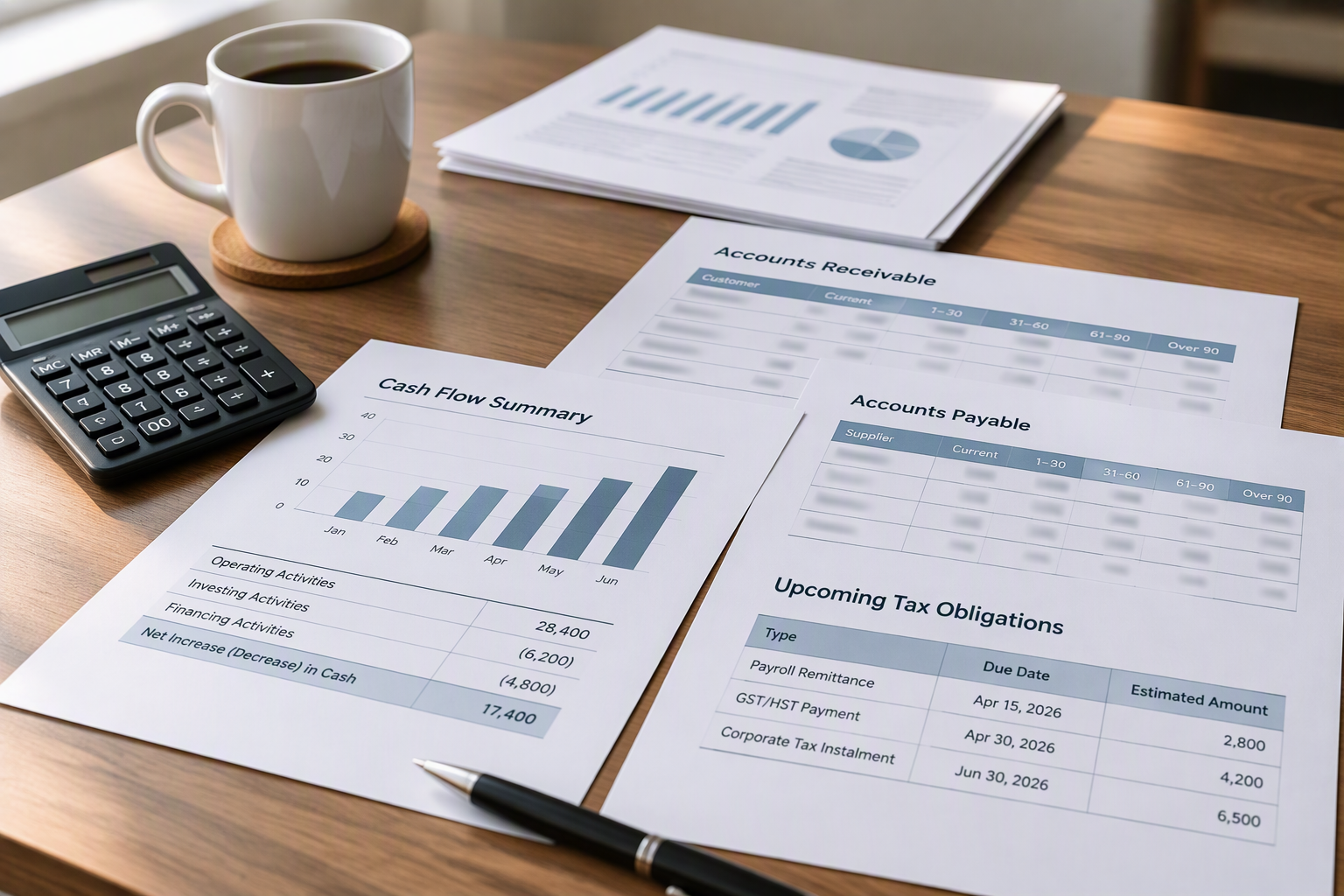
Cash flow, taxes and bookkeeping should be reviewed together because each one explains a different part of the business’s financial position. Bookkeeping records what has occurred, cash-flow review considers when money moves, and tax information identifies obligations that may affect the available cash.
Reviewing these areas together can help identify whether recorded results agree with cash movement, whether customer receipts are expected in time to meet commitments, and whether upcoming remittances, instalments or balances have been included in the cash plan.
This monthly review is a planning framework, not a forecast guarantee. Its usefulness depends on complete records, realistic assumptions and regular follow-up.
For more practical financial and business decision guides, visit the ACCPAS Insights resource centre.
This guide brings cash flow taxes and bookkeeping into one monthly review so the business can compare recorded results, expected cash movement and upcoming obligations.
6 monthly cash flow, taxes and bookkeeping checks
1. Begin with reliable bookkeeping
Confirm that routine transactions have been recorded through the review date and that relevant bank, credit-card, loan and payment-processor accounts have been reconciled.
Review outstanding suspense balances, duplicate entries, missing transactions and unsupported adjustments. A cash-flow review built on incomplete bookkeeping may mistake a recording problem for a cash problem.
The bookkeeping does not need to be perfect before every monthly discussion, but known gaps and estimates should be identified clearly.
2. Review operating cash movement
Compare opening cash, closing cash, customer receipts, supplier payments, payroll, financing payments and owner transactions. Separate ordinary operations from financing activity, major asset purchases and unusual one-time transactions.
Profit and cash are not the same measurement. The internal ACCPAS financial-reporting guidance notes that the cash-flow statement explains changes in cash and should be reviewed with the other reports rather than treating one number in isolation
Reviewing cash flow taxes and bookkeeping together helps distinguish routine operating activity from financing, major purchases and tax-related cash requirements.
3. Connect receivables and payables
Review aged receivables to determine which customer payments are expected and whether any amounts require follow-up. Review payables and committed expenses to identify amounts that must be paid and the applicable timing.
A profitable period may still create cash pressure when customers have not paid or when supplier, payroll, debt or tax obligations fall due sooner than expected.
Distinguish confirmed dates from estimates. Record who is responsible for following up on uncertain receipts or payment timing.
4. Add tax and remittance obligations
Include payroll remittances, GST/HST payments or instalments, corporate-tax instalments and expected balances where applicable. Keep these obligations separate from ordinary supplier expenses so they remain visible in the cash plan.
Corporate-tax instalment dates depend on the corporation’s tax year and whether instalments are monthly or quarterly. Payroll remittance dates depend on the employer’s remitter type and relevant circumstances. GST/HST instalment obligations and timing depend on the registrant’s filing circumstances.
Do not copy dates from a generic calendar without confirming that they apply to the business.
5. Confirm the correct dates
Filing deadlines, payment deadlines, instalment dates and reporting periods may differ. Review each obligation using the correct program account, reporting period and due date.
The CRA maintains separate payment-due-date guidance for corporate income tax, GST/HST and payroll obligations. Where available, confirm account-specific dates through the approved CRA account or current professional records.
Keep the due date, expected amount, responsible person and payment status visible in the monthly review.
6. Create one monthly review
Summarize the current cash balance, expected customer receipts, committed payments, payroll, tax obligations, financing payments and planned purchases. Identify assumptions and shortfall risks separately.
Compare the current review with the previous month. Record which assumptions changed, which actions were completed and which issues remain outstanding.
A repeatable review is more useful than a complex forecast that is not updated.
Integrated monthly review
- Bookkeeping updated through the review date
- Bank and credit-card accounts reconciled
- Current cash balance verified
- Expected customer receipts listed
- Supplier and operating commitments listed
- Payroll amounts and payment dates listed
- Payroll remittance obligations confirmed
- GST/HST obligations included where applicable
- Corporate-tax instalments or balances included where applicable
- Debt and financing payments listed
- Major purchases and owner payments identified
- Shortfall risks and assumptions documented
- Follow-up owners and target dates assigned
Use this cash flow taxes and bookkeeping checklist to connect current records with expected receipts, committed payments and upcoming obligations.
Common monthly review issues
A combined review may identify gaps requiring further investigation. Common issues include:
- Bookkeeping that is not current
- Bank or credit-card accounts that have not been reconciled
- Profit treated as though it were available cash
- Customer receipts forecast without considering collection timing
- Payroll or supplier commitments omitted from the cash plan
- GST/HST or payroll amounts excluded from upcoming obligations
- Corporate-tax instalments based on outdated assumptions
- Financing payments or major purchases omitted
- Owner withdrawals included without reviewing corporate cash needs
- Filing dates confused with payment dates
- Estimates that are not identified as estimates
- Follow-up actions without a responsible person or review date
Document each unresolved item and distinguish confirmed amounts from estimates. If the bookkeeping, tax obligation or reporting treatment is uncertain, obtain professional advice before relying on the review for a material decision.
How ACCPAS can help
ACCPAS can help review cash flow, taxes and bookkeeping together by organizing current financial information, identifying reconciliation gaps and connecting upcoming obligations to the business’s available cash and expected receipts.
That may include reviewing cash assumptions, receivable and payable timing, payroll and GST/HST obligations, corporate-tax instalments and material planned transactions. The objective is a clearer, fact-based monthly discussion, not a guaranteed cash or tax outcome.
Want a monthly review that connects bookkeeping, cash commitments and tax obligations?
Bring the current financial reports, cash balances, receivable and payable information, upcoming obligations and list of planned transactions or questions.
Keep the completed cash flow taxes and bookkeeping review with the current financial reports, obligation schedule and list of assumptions or follow-up items.
Sources
CRA: Due dates for amounts you owe
CRA: Corporate income-tax payment due dates
CRA: Corporate income-tax payments
CRA: When to remit payroll deductions
CRA: GST/HST instalments
CRA: GST/HST instalments due dates